Resources

Search terms: empathy

Lakeman, R., (2023, 13th of October). Advanced Empathy: An Accelerated Workshop. Presented at the New South Wales Nurses and Midwives Association, Mental health Nursing Symposium, Held at Ridges Surrey Hills.

Empathy is essential for interpersonal helping and is considered a key change process in psychotherapy (1). To empathise with another is to see things from their perspective and to feel with them, or to use the metaphors ‘to walk in their shoes’ or to ‘look from their window’. It is widely understood and defined as “… the action of understanding, being aware of, being sensitive to, and vicariously experiencing the feelings, thoughts, and experience of another of either the past or present without having the feelings, thoughts, and experience fully communicated in an objectively explicit manner” (2). Empathy connotes more than a sympathetic relating to another person’s observed mental state or the automatic mirroring of contagious emotion whether sorrow, fear or triumph (3). Empathy is a deliberate rather than passive process and involves perceptual, cognitive, emotional regulation and communicative processes. To be usefully employed in the process of helping, an empathic understanding of another’s experience (including thoughts and feelings) needs to be communicated back to the person in a congruent, non-judgemental way which makes a difference to them. Indeed, it is this communication of understanding this sense of being not only heard but understood that makes empathy so powerful. Everyone wants to be understood!
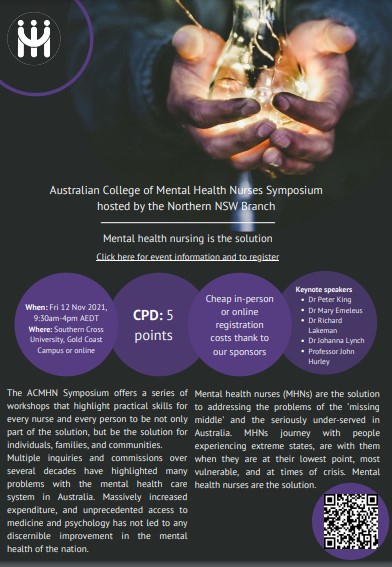
Lakeman, R. (2021, 21st November). ‘Building alliances, being empathic and being with people on their journeys'. Mental health nursing is the solution’. Australian College of Mental Health Nurses Symposium hosted by the Northern NSW Branch. Held online and at the SCU Gold Coast Campus.

This part workshop and part presentation acknowledges the crucial role of connection and alliance with people in extreme states to facilitate recovery, growth and wellbeing. Mental health nurses are a unique professional group in that they spend lengthy periods of time with people in extreme states across the lifespan, in varying contexts with mental health and psychosocial problems which may be framed as mental illness. In this workshop the importance of communicating with empathy as a therapeutic tool will be reinforced and highlighted as an essential element of recovery focused and trauma informed care. Participants will be invited to consider how to do this in a recovery focused way in whatever context they might work and with people in extreme states.

Lakeman, R., Foster, K., Hazelton, M., Roper, C., & Hurley, J. (2023). Helpful encounters with mental health nurses in Australia: A survey of service users and their supporters .Journal of psychiatric and mental health nursing, 30(3), 279-593, https://doi.org/10.1111/jpm.12887

Introduction
Successive inquiries into mental health services in Australia have identified the need for major reform of services and proposed a return to direct-entry nursing training.
Aim/Question
To identify what service users, family and supporters have found helpful in their encounters with nurses in mental health settings.
Method
A survey of 95 service users and supporters rated the importance of the capabilities and competencies of nurses. They also shared examples of helpful encounters with nurses which were subject to thematic analysis.
Results
The most highly rated competencies were around demonstrating caring, empathy and understanding, and responding effectively in crisis situations. Helpful encounters involved enacted values, highly skilful interpersonal and psychotherapeutic engagement and practices that were facilitative and supportive.
Discussion
The process and content of pre-registration nursing training needs to refocus on the nurse meeting the needs of service users and supporters, rather than the instrumental needs of services today.
Implications for practice
Educational reform may be necessary but insufficient to address anticipated nursing workforce shortages. Policymakers and health service directors need to align services with mental health nursing values and promote practices aligned with what service users and their supporters report as helpful.

Lakeman, R. (2020). Advanced empathy: A key to supporting people experiencing psychosis or other extreme states. The Psychotherapy and Counselling Journal of Australia. 8(1), DOI: https://doi.org/10.59158/001c.71092

The capacity to be empathic and communicate empathically are foundational skills of counselling and psychotherapy, if not all interpersonal helping endeavours. Empathy requires the capability, inclination and capacity to take the perspective of others, appraise and understand their experience without being overwhelmed, and communicate this understanding in a helpful way to the other person. This paper reviews and highlights the importance of this interpersonal capability and describes a form of ‘advanced empathy’ characterised by the capacity to take the perspective of others experiencing extreme states, making sense of this experience and conveying an understanding of that experience in a way which is useful to the person. The capacity for ‘advanced empathy’ is a foundation for any kind of therapeutic work with people who may express delusional or disturbing ideas and will be helpful for anyone needing to develop or maintain a relationship with people in extreme states. These ideas have been tested in practice and with a wide variety of audiences. This synthesis and summary might therefore be useful for training, supervision or reflection by those who hope to build alliances with people who may be in crisis, experience psychosis or are ‘out of step’ with people around them. This paper argues that empathy is useful in most helping relationships but is essential to effective mental health care.

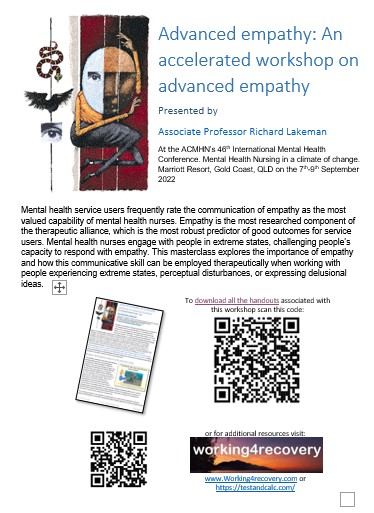
Lakeman, R. (2022, September 7-9). Advanced Empathy: A Masterclass. Presented ACMHN’s 46th International Mental Health Conference. Mental Health Nursing in a climate of change. Marriott Resort, Gold Coast, QLD.

Mental health service users frequently rate the communication of empathy as the most valued capability of mental health nurses. Empathy is the most researched component of the therapeutic alliance, which is the most robust predictor of good outcomes for service users. Mental health nurses engage with people in extreme states, challenging people’s capacity to respond with empathy. This masterclass explores the importance of empathy and how this communicative skill can be employed therapeutically when working with people experiencing extreme states, perceptual disturbances, or expressing delusional ideas.

Note that the video link is a truncated / edited workshop undertaken at a previous symposium.

Lakeman, R. (2010, 10-11 November). Mental Health at the Movies: Incapacity, injustice and Entertainment Paper presented at the Critical positions on and beyond recovery: The Dr Michael Corry Memorial Conference, University College Cork.

The impact that movies have had on the public perceptions of madness cannot be underestimated. Iconic movies such as 'One Flew Over the Cuckoos Nest' captured the zeitgeist of the time, both reflecting and fomenting a healthy disrespect for authority and a suspiciousness of total institutions. The way madness is represented in the movies also in part reflects our views and fears of madness. The characters can evoke our sympathy or provoke horror. Movies can play a role in reinforcing stigma, and perpetuating falsehoods, but conversely they may normalise some experiences, evoke empathy, spur people to action and capture truths of how mental distress and problems of living are conceived. This presentation invites people to the movies, to view some Oscar winning and B grade performances which illustrate how conceptions of mental health have changed. At a time when incapacity legislation is being debated these snippets can be informative as to the extent to which people's capacity is under-estimated, the shifting nature of psychiatric diagnosis, and gaps in our collective social imagination perpetuate various forms of injustice. They can also be fascinating and fun!

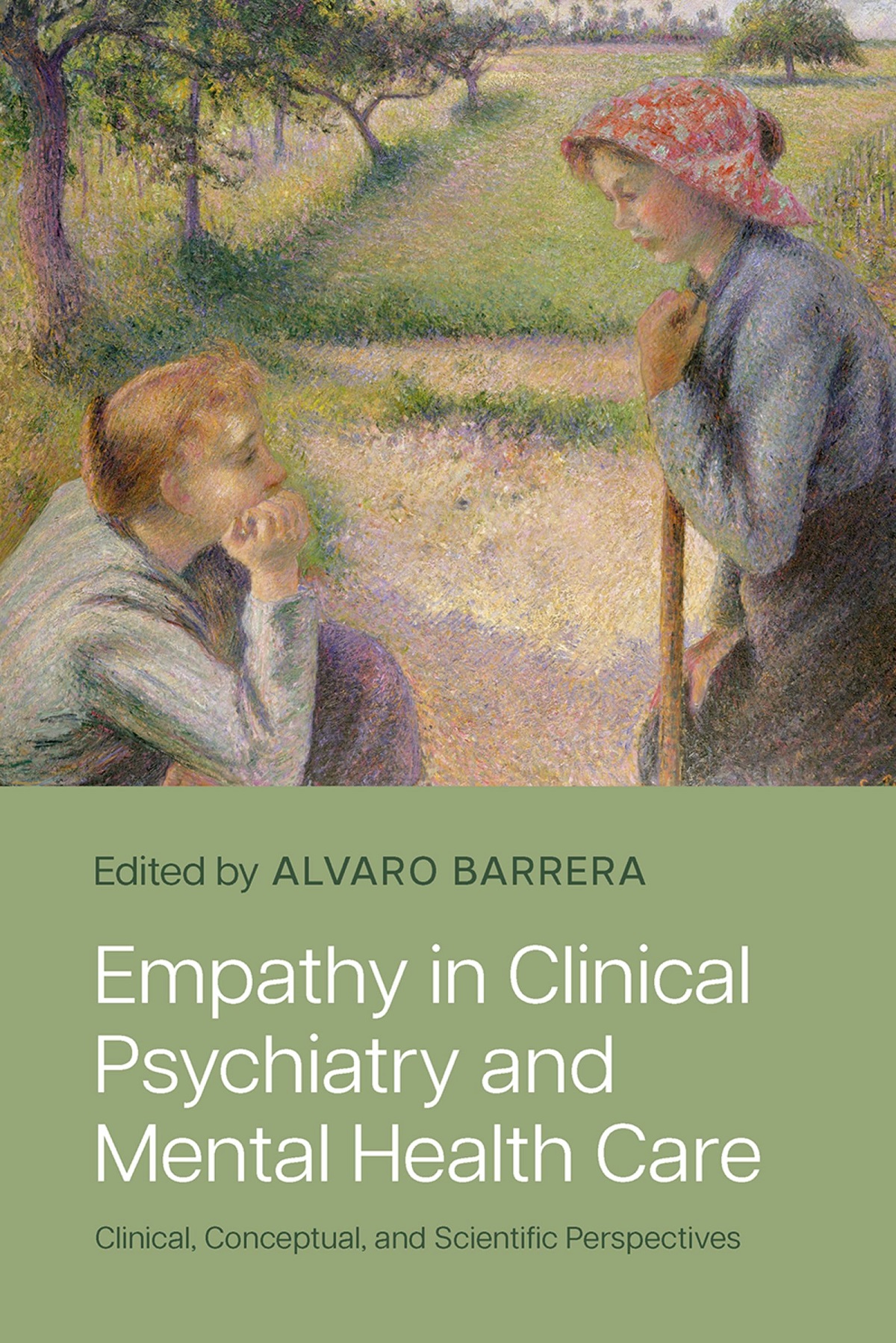
Lakeman, R. (2025) Empathy and the care of people experiencing psychosis. In A. Barrera (ed). Empathy in Clinical Psychiatry and Mental Health Care (pp. 113-126). Oxford University Press. https://doi.org/10.1093/med/9780198917328.003.0010

When Carl Rogers famously hypothesized the necessary and sufficient conditions for therapeutic change (1) he perhaps did not have psychosis at the forefront of his mind. Rogers emphasized the pivotal role of empathy in fostering personal growth and invited the therapist to enter the client’s private world, being sensitive to changing meanings and developing a deep intuitive grasp of the client’s emotions and experiences. Empathy, and in particular the therapist’s ability to perceive the internal frame of reference of the client with nuanced accuracy and to communicate this back to the client, was fundamental for the goals of therapy, which were principally around personality growth. Empathy is a deliberate rather than passive process and involves perceptual, cognitive, emotional regulation, and communicative processes. To be usefully employed in the process of helping (and as discussed in this chapter), empathy is a communicative process. It involves an understanding of another’s experience (including thoughts and feelings), which is communicated to the person in a congruent, non-judgemental way that makes a difference to them.

There are 7 items displayed